From Physical Galleries to Digital Art Experiences
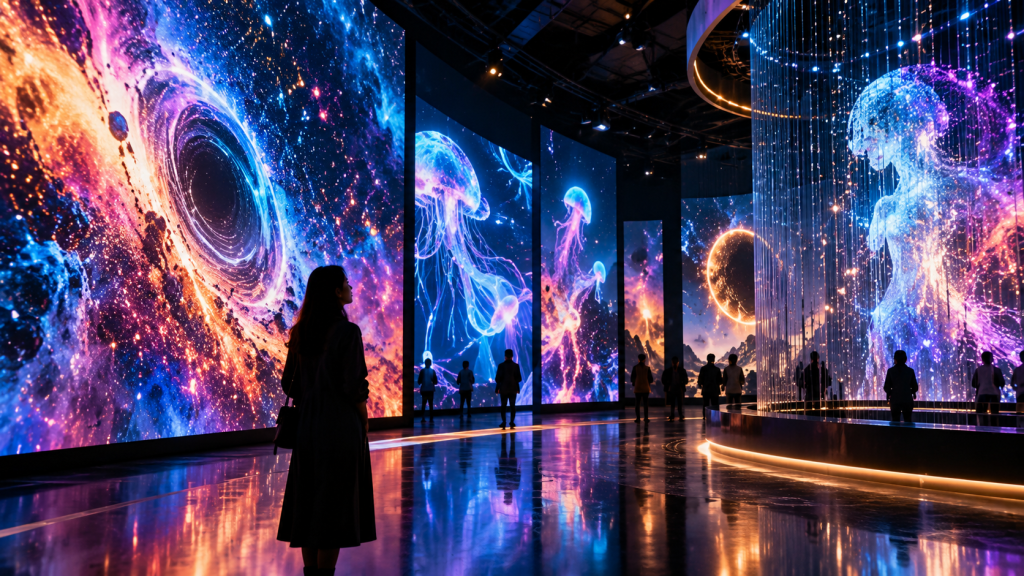
A gallery visit traditionally involves moving through rooms, looking at objects, and reading the information displayed beside them. Digital art can preserve that structure, but it can also replace the passive encounter with an experience that responds to the visitor. A work might change as someone walks, speaks, touches a screen, or contributes data through a browser.
From objects to systems
A painting or sculpture may be physically stable while its interpretation changes. Interactive digital work can change at the level of the object itself. Software responds to input, generative rules produce new variations, and networked installations may depend on participants who are not in the same room.
That shift complicates the familiar question of what an artwork is. Is it the code, the displayed image, the sequence of actions, or the visitor’s experience? Different works require different answers. Curators increasingly need to explain behavior as well as appearance.
Early digital and interactive traditions
Digital art did not begin with recent virtual worlds or collectible tokens. Artists have used computers, video systems, sensors, and telecommunications for decades. Early experiments with algorithmic drawing and electronic images established the possibility of creating works through procedures rather than fixed manual marks.
Interactive installations later gave audiences a more active role. Cameras, motion tracking, and responsive projections made a visitor’s movement part of the composition. Contemporary browser-based experiences inherit many of these ideas while making distribution easier outside a dedicated venue.
The visitor becomes a participant
Participation can be simple: choosing a path through an exhibition, changing the color of a projection, or triggering a sound. It can also be social, as multiple visitors contribute to a shared work. In either case, the design defines which choices are possible and how those choices influence the outcome.
Not every interactive element creates meaningful agency. A button that produces a decorative animation may be engaging but does not necessarily change the artistic argument. Strong installations make the relationship between action and response worth examining.
Generative art and controlled unpredictability
Generative systems use rules to produce variations. A work might rearrange shapes according to a random seed, simulate the growth of a pattern, or respond to incoming measurements. The artist defines the system’s boundaries even when the exact result is not chosen in advance.
Randomness should not be confused with complete independence. A pseudorandom sequence can be reproducible when its seed and algorithm are known. The article on random number generators explains the underlying distinction, which applies to games and creative software alike.
Browser exhibitions and access
An online exhibition can reach people who cannot travel to a physical institution. Browsers also allow artists to combine text, moving images, sound, and interaction in one accessible link. That flexibility can support education, experimentation, and wider circulation of work.
Access is not automatic, however. Large files can be difficult on slow connections; touch interfaces may require different controls from desktop installations; and some experiences are unusable without captions or keyboard navigation. Browser technology offers useful tools, but designers still have to account for the people using them.
Sound, space, and immersion
Immersive art often depends on more than a large screen. Spatial sound, responsive lighting, projection geometry, and the timing of events can establish a sense of presence. The audience may experience a work as an environment rather than as a sequence of images.
Data-driven projects add another layer. A sensor or scientific dataset can influence what visitors hear or see. Fallen Gravity illustrates the cultural interest in connecting digital sound and imagery to the language of orbit, while reminding us to distinguish measured data from artistic interpretation.
Ownership is not the same as preservation
Digital files can be copied, but copying alone does not preserve a functioning artwork. Software may rely on servers, proprietary libraries, or obsolete hardware. A token associated with an image may survive while the original interactive experience disappears.
Institutions therefore document installation instructions, source files where possible, screen recordings, and the conditions under which a work was shown. Rights agreements matter too: an archive may possess a copy but lack permission to migrate it to a new platform.
What galleries must explain
Visitors benefit from knowing which parts of an experience are automated, which respond to them, and what information is collected. A microphone-based installation should disclose why it needs access. A generative piece should explain enough of its rules to support interpretation without reducing the work to a technical manual.
A useful label can describe the artist’s intention, the audience’s role, and the technology’s limits. These details make digital work more legible, especially for people encountering it for the first time.
Interactivity changes authorship
In a conventional exhibition, a visitor may choose where to stand or how long to look, but the artwork itself often remains materially stable. An interactive installation can make the visitor a participant in the sequence of events. Movement may alter a projection; touch may change a soundscape; a submitted phrase may become part of a collective display. That does not necessarily transfer authorship to the audience. The artist still defines the system, its limits, and the possible responses. The most revealing question is which choices genuinely change the work and which merely create an impression of control.
What immersive spaces demand
Projection rooms and responsive environments can create a strong sense of presence, but they also introduce physical constraints. The geometry of a room affects sightlines. Brightness and ambient sound influence whether details remain visible and intelligible. Crowds change the experience when a work responds to movement or requires individual interaction. Accessibility is not a small technical appendix: visitors may need a seated route, a quieter session, captions, or a way to understand the piece without participating in intense visual effects. Curators must plan for those conditions as carefully as they plan the artwork itself.
A digital gallery still needs curatorial work
Publishing images on a website is not the same as building a coherent exhibition. A digital gallery needs context, sequencing, image descriptions, artist credits, rights information, and a navigation structure that makes sense without a physical floor plan. High-resolution media can reward close inspection while excluding visitors with slow connections. Interactive features can deepen engagement but can also obstruct a simple reading of the work. Thoughtful curators offer multiple ways in: a short overview, a detailed interpretation, and accessible alternatives for complex interactions. The medium changes, but the responsibility to explain and preserve cultural objects remains.
Conservation after the software ages
Traditional conservation may focus on the physical condition of an object. Software-based art adds dependencies on operating systems, browsers, servers, licenses, and proprietary devices. A piece that once ran perfectly can become inaccessible when a service closes or an interface changes. Institutions must decide whether to preserve the original hardware, emulate an old environment, migrate the work to a newer platform, or document its behavior through recordings. Each option changes the audience experience. A migration may restore usability while subtly altering timing or appearance. Recording those decisions is part of the artwork’s history, not merely technical housekeeping.
The future is not entirely virtual
Physical galleries and digital experiences are not mutually exclusive. Museums can use online tools to extend an exhibition, while artists may deliberately create installations that require a particular room or shared physical presence. The important change is the growing range of ways an audience can encounter a work. The strongest projects choose their medium because it serves the idea, not because a new platform happens to be available.